

When an innovative drug moves into international markets, patent translation should not be treated as the final step once the documents are ready. For companies using the PCT system to build a global patent portfolio, terminology, claim language, and patent family consistency all need to be considered from the application stage onward.
According to WIPO’s PCT Yearly Review 2026, 275,900 international patent applications were filed under the PCT in 2025. Applicants from China filed 73,718 applications, the highest number among all countries of origin. In 2024, around 645,100 PCT applications entered the national phase worldwide.
For innovative drug companies, the real challenge is not whether one particular document has been translated correctly. It is whether the same technical concepts and terminology can remain consistent as the patent moves from the PCT application to national phase filings and, later, through ongoing prosecution.

1. What Is Innovative Drug Patent Translation?
Innovative drug patent translation is a specialized language service that covers pharmaceutical chemistry, biotechnology, medicine, and intellectual property. Depending on the project, it may involve PCT application documents, patent specifications, claims, abstracts, national phase filings, Office action responses, and other patent prosecution materials.
Accuracy is only one part of the job. A patent translation also needs to preserve the intended claim language, technical meaning, and terminology across related documents.
That is particularly important for innovative drugs, where the same technical concept may appear repeatedly throughout a patent and then reappear in later filings, amendments, and responses during prosecution.
2. How Is Pharmaceutical Patent Translation Different from General Medical Translation?
General medical translation is primarily about communicating medical information accurately. Typical projects include drug labeling, medical literature, clinical research documents, and regulatory materials.
Patent translation has another layer of complexity. The translator has to deal with the technology itself while also preserving the structure and logic of patent language.
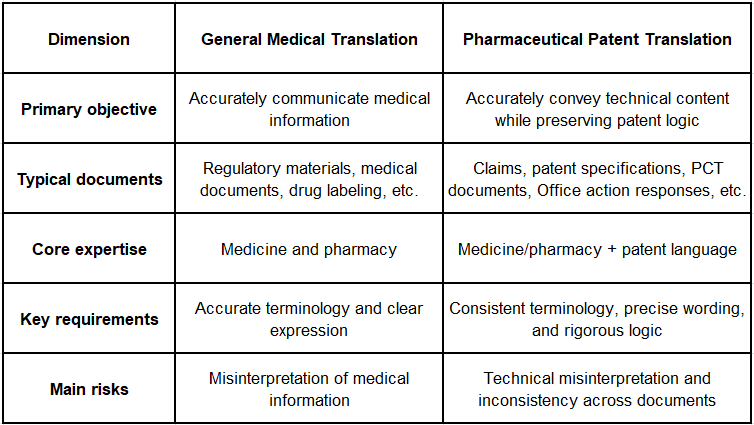
The difference becomes especially important in the claims. A small change in wording can affect how a technical feature or limitation is interpreted. That is why pharmaceutical patent translation cannot simply follow the same approach as general medical translation.
Life sciences patents are also becoming increasingly complex. According to the China chapter of Life Sciences 2026 published by Chambers and Partners, ADC-related patents accounted for 18% of biopharmaceutical patent applications in China in 2025, followed by gene-editing-related patents at 15% and cell therapy-related patents at 12%.
For translation teams, that means the challenge is not simply keeping up with more terminology. They also need to understand increasingly sophisticated technologies and the way those technologies are defined in patent documents.

3. Why Should Patent Translation Start Before the National Phase?
Many companies wait until they have decided which countries to enter before commissioning patent translation for the relevant languages. There is nothing inherently wrong with that approach, but it often leaves a series of language decisions to be made after the patent strategy is already underway.
3.1 Terminology Established Early Can Be Used Throughout the Patent Lifecycle
Core terminology in an innovative drug patent rarely appears only once.
Terms relating to active ingredients, targets, antibodies, payloads, linkers, indications, formulations, dosing regimens, and biomarkers may appear throughout the specification and claims, and later in Office action responses and amendments.
Without a consistent terminology framework in place from the beginning, every new language can bring another round of terminology checks and cross-document review.
The point of terminology management is therefore not just to make one translation more consistent. It gives the entire patent family a reliable language foundation that can be reused over time.
3.2 Early Language Differences Can Become More Complicated Across a Patent Family
As innovative drugs expand into overseas markets, companies often pursue patent protection in different countries and regions based on their commercial priorities and IP strategy.
At that stage, the language challenge becomes much broader than translating one source document into another language. The same technology needs to be represented consistently across different languages and jurisdictions, particularly when it comes to core terminology and technical features.
Suppose the same concept is translated differently in two national filings. When the documents are later compared, amended, or used to prepare an Office action response, the team may have to determine whether the difference reflects an intentional legal distinction or simply a translation choice.
That is why it is much easier to manage patent-family language when the basic terminology and technical references have already been mapped out at an early stage.
3.3 An Office Action Response Is Part of the Patent Record, Not a Standalone Translation
Patent prosecution does not end when the national phase filing is submitted. Applications may go through multiple rounds of examination, amendments, and responses.
New Office action responses and amended claims need to remain aligned with the documents that were filed earlier. Translating each response as a completely new assignment can easily break that continuity.
A better approach is to go back to the original application, the previously filed claims, and the existing translations before working on the new document. The team can then confirm how key terminology and technical concepts were handled in the earlier filings and apply the same language wherever appropriate.
The more work that is done upfront, the easier it becomes to trace language decisions across the patent record later on.
For companies pursuing multi-country patent protection, that is a strong reason to bring language planning into the process as early as possible.

4. What Are the Main Risks in Innovative Drug Patent Translation?
The risks in innovative drug patent translation go well beyond mistranslating an individual term. What makes these projects difficult is the connection between technical content, patent language, and the documents that follow.
4.1 Technical Terminology: New Technologies Require Ongoing Management
Small-molecule drugs, biologics, antibody-drug conjugates, cell therapies, gene editing, and nucleic acid therapeutics all involve highly specialized terminology.
In fast-moving fields, the same concept may be described differently in R&D documents, patent applications, and other technical materials.
A professional workflow therefore needs to do more than find an equivalent term. The team needs to determine whether the terminology is technically accurate, appropriate for the patent context, and suitable for continued use in later documents.
This is where terminology development and terminology database management become particularly important.
4.2 Claim Language: Patent Drafting Has Its Own Logic
A patent specification can explain the technical background, experimental results, and embodiments in considerable detail. Claims serve a different purpose: they define the scope of the protection being sought.
That makes claim translation particularly sensitive to:
- the relationship between independent and dependent claims;
- numerical ranges and limiting conditions;
- functional limitations;
- Markush structures;
- open-ended and closed-ended language; and
- references to the same technical feature across different parts of the claims.
These issues cannot be handled simply by making the English sound natural.
The translator needs to understand the underlying technology and recognize which expressions carry legal or technical weight, as well as which terms need to remain consistent throughout the document.
That is why a good patent translation should not be judged by fluency alone.
4.3 Patent Family Consistency: Terminology and Technical Concepts Need to Stay Traceable
Managing language across a patent family does not mean forcing every language into a literal, sentence-by-sentence translation.
What matters is maintaining a clear and traceable relationship between the terminology and technical concepts used across different family members.
The same invention may appear repeatedly in the PCT application, national phase documents, translations of related applications, and later amendments.
When each translation is handled independently, previously established terminology and wording are easily lost.
When companies build a patent terminology database, translation memory, and language mapping early in the process, later projects can draw on those existing language assets rather than starting from scratch.
4.4 Office Action Responses: New Wording Should Follow Established Language
Office action responses may involve amended claims, arguments addressing examination objections, and further explanations of technical features.
One common problem is that a translator may unintentionally change established technical wording simply to make the new document read more naturally.
That is why Office action responses are best handled through a clear language traceability process:
Original Application → Previously Filed Claims → Historical Translations → Current Office Action → Amendments or Response
Following that chain allows the team to verify established terminology and technical references before introducing any new wording.
The goal is simple: a new translation should build on decisions that have already been made, rather than forcing the project team to revisit them every time a new document arrives.
These four risks are closely related
A term that was never standardized can lead to inconsistent wording across national filings. Those differences can make claim review more difficult later. By the time an Office action arrives, the team may have to reconstruct years of language decisions if earlier translations and terminology records are not readily available.
That is why innovative drug patent translation is better viewed as an ongoing language management process than as a series of individual translation assignments.
For companies building a global patent portfolio, the work that needs to start early is not translation alone. Terminology, patent-family language planning, and consistency across future filings all deserve attention from the PCT stage onward.
In Part 2, we will look at how language planning can be coordinated from the PCT application through national phase entry, Office action responses, and regulatory documentation—and how AI can be incorporated into the process while keeping risk under control.
About Glodom
Glodom is an innovative language technology solutions provider with extensive project experience in the patent services field and long-term partnerships with many Fortune Global 500 companies and professional institutions. Glodom has more than 300 full-time employees and a network of over 10,000 native-speaking translation experts across more than 40 countries worldwide. We support more than 200 languages and provide efficient, accurate language support for patent filing, patent translation, patent invalidation, patent litigation, and related technical materials.We consistently balance professional capability with service efficiency. With a mature terminology management system, rigorous quality control processes, and extensive cross-language project experience, we continue to help companies address language challenges in international patent matters and strengthen compliance and competitiveness in global expansion.
