

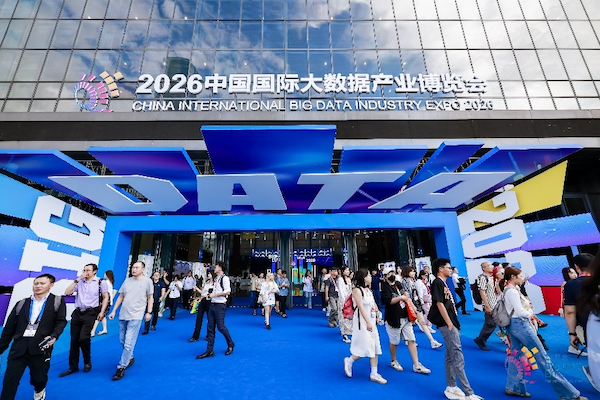
The 2026 China International Big Data
Industry Expo took place in Guiyang, Guizhou, from August 28 to 30, bringing
together companies, institutions, and industry professionals working across
data, artificial intelligence, computing power, and the digital economy.
Held under the theme “Token: A New Path to
Value of Data Elements,” this year’s expo explored five major areas: computing
infrastructure, data supply, model-driven development, security, and
intelligent experiences. High-quality datasets, data annotation, data
infrastructure, and data standardization were among the key areas of focus.
Over the three-day event, the expo hosted
89 activities, welcomed 372 exhibitors from China and abroad, attracted more
than 41,000 visits, and featured 87 newly released innovations.
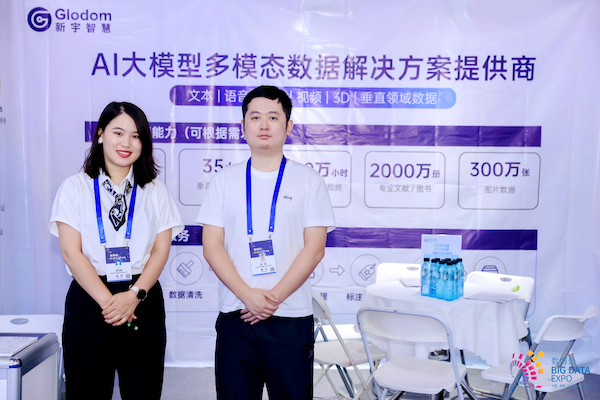
Glodom was among the exhibitors, showcasing
AI data service solutions, multilingual data, and industry-specific datasets at
Booth W2F11 in the Guiyang International Conference and Exhibition Center.
Throughout the event, we spoke with companies, industry partners, and clients
from a range of sectors about practical challenges in data collection,
processing, annotation, quality control, and dataset development.
1. Data Is Becoming an Input for AI, Not Just a Resource
One theme came through clearly at this
year’s expo: the conversation around data is moving closer to application.
It is no longer enough to ask how much data
an enterprise has. The more important questions are how that data can be used
by AI models, whether it meets the requirements of a particular application,
and how it can consistently deliver value throughout the AI lifecycle.
High-quality datasets and data annotation
were prominent topics at the expo. Industry sessions and activities such as the
“Data Market” focused on connecting data supply and demand with technical
services and AI applications.
The shift reflects where the AI industry is
today.
As large language models, AI agents, and
multimodal applications move into real-world use, enterprises are becoming more
selective about the data they rely on. Accuracy matters, but so do structure,
consistency, task relevance, and the ability to reuse data for training,
fine-tuning, evaluation, and deployment.
In practice, this means data quality has to
be considered from the beginning. Collection is only one step. Data needs to be
cleaned, processed, annotated, reviewed, and aligned with clearly defined
standards based on how it will ultimately be used.
2. Glodom Showcases Data Services Across Modalities and
Industries
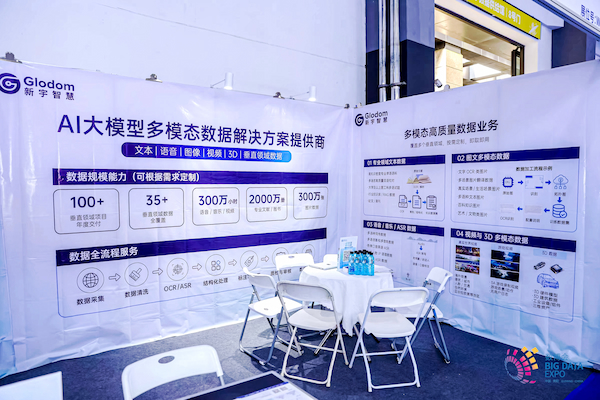
At Big Data Expo 2026, Glodom presented its
AI data services alongside multilingual and industry-specific data solutions.
Our data services cover the workflow from
data collection and cleaning to processing, annotation, quality control, and
dataset development. They support a range of data types, including text, audio,
images, video, and 3D content.
The right approach depends on the project.
Glodom supports text data processing,
speech transcription and annotation, image and video annotation, 3D data
processing, multilingual data development, and the development of datasets for
specific industries and use cases.
The goal is to turn raw data into datasets
that are genuinely usable for AI applications. That can involve cleaning and
categorizing source data, applying annotations, revising content, and carrying
out quality checks before the final dataset is delivered.
Different stages of the AI lifecycle also
call for different types of data.
Training datasets need sufficient scale,
quality, and coverage. Fine-tuning datasets need to closely reflect the target
task and business context. Evaluation datasets require clear criteria and
carefully controlled quality so that model performance can be measured
consistently.
For this reason, there is no
one-size-fits-all approach to AI data. Data standards and processing workflows
need to be defined around the intended application, with quality checks built
into the process rather than added at the end.
3. Multilingual and Industry-Specific Data Matter More as
AI Goes Global
Multilingual data was another recurring
topic in conversations at the expo.
For companies operating across markets, AI
systems often need to work with the same type of content in several languages,
including Chinese, English, Japanese, German, and Spanish. Building
multilingual models or developing AI products for international markets
therefore involves more than translating content.
The data also needs to stay aligned across
languages. Terminology must remain consistent, equivalent content needs to be
mapped correctly, and quality needs to be controlled across the entire dataset.
Industry-specific data presents a similar
challenge.
Healthcare, financial services,
manufacturing, gaming, and intellectual property all have their own
terminology, conventions, and business requirements. General-purpose datasets
may not provide enough domain coverage for applications in these areas.
Developing datasets with the right industry
knowledge and task-specific requirements is becoming increasingly important as
AI moves into more specialized use cases.
Glodom brings its experience in language
services and industry-focused projects to this area, providing a foundation for
multilingual and industry-specific data development.
4. What We Took Away from the Expo
After three days of conversations at the
expo, one thing became increasingly clear: when companies talk about AI, the
conversation is moving beyond models.
The real question is whether the data
behind those models can support the applications businesses actually need.
High-quality datasets, data annotation,
data standardization, and application-specific data development all play a role
in bridging that gap. As AI becomes more deeply integrated into business
processes, data is becoming an essential link between a model and the
real-world environment in which it operates.
That also changes the role of AI data
services.
Data work does not stop once a model has
been trained. Enterprises may need new datasets for fine-tuning, additional
data for evaluation, or ongoing data development as products and applications
evolve.
Glodom is continuing to build its AI data
services around these practical requirements — supporting projects from data
collection and dataset development to multilingual and industry-specific data
solutions.
5. Looking Ahead
Big Data Expo 2026 lasted just three days,
but the conversations in Guiyang gave us a closer look at how enterprise data
requirements are changing alongside AI.
For Glodom, participating in the expo was
not only an opportunity to present our existing capabilities. It was also a
chance to listen to clients and industry partners, understand new application
scenarios, and see where their data challenges are heading.
We will continue to develop our
capabilities in multilingual, industry-specific, and multimodal data, with a
focus on building data services that fit the practical requirements of AI
applications.
